
News Summary
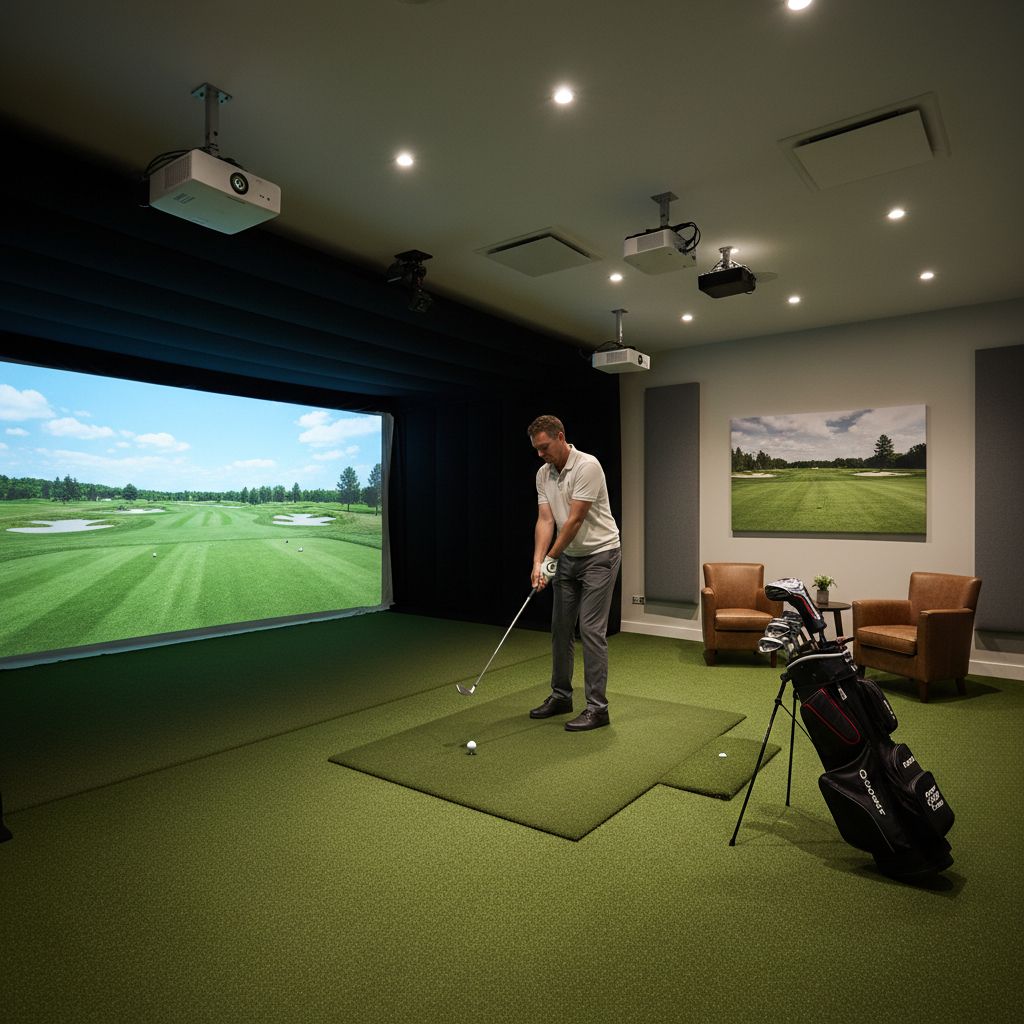
The Golf Simulators Market is projected to grow significantly, from USD 1.6 billion in 2024 to USD 5.6 billion by 2034, driven by technological advancements and changing consumer preferences. Innovations like VR and AI are enhancing user experiences, promoting year-round practice, and attracting a younger demographic. The market is segmented into hardware and software, with commercial venues leading in demand, while residential adoption is rapidly increasing. Despite challenges such as high installation costs, the outlook remains positive as the appeal of golf rises globally.
Nationwide: Golf Simulator Market Surges with Robust Growth Projections
The global Golf Simulators Market is currently experiencing a significant upward growth curve, driven by technological advancements and evolving consumer preferences. Valued at an estimated USD 1.6 Billion in 2024, the market is projected to reach USD 5.6 Billion by the year 2034, demonstrating a substantial Compound Annual Growth Rate (CAGR) of 13.2% during the forecast period from 2025 to 2034. This robust expansion underscores the increasing integration of sophisticated virtual environments into the sport, allowing golfers to practice and play regardless of external conditions.
Driving Forces Behind the Market Expansion
The notable surge in the golf simulator market is primarily fueled by continuous technological advancements. Innovations such as high-definition visual displays, precision motion-tracking sensors, and advanced simulation software are significantly enhancing the accuracy and realism of virtual golf experiences. The integration of virtual reality (VR) and augmented reality (AR) technologies further strengthens market appeal by delivering highly interactive and immersive user experiences. Moreover, the incorporation of artificial intelligence (AI)-powered analytics is transforming training, providing real-time swing analysis and personalized coaching tips to help players refine their techniques more efficiently.
Changing consumer lifestyles and a growing interest in customized home entertainment and recreational spaces are also pivotal factors, particularly among high-income consumers, leading to increased residential adoption of golf simulators. These systems offer the convenience of year-round practice, unhindered by weather conditions, contributing to consistent skill development and an enhanced golf experience. The global popularity of golf is on the rise, extending to younger demographics and urban professionals who seek convenient and accessible ways to engage with the sport. The expansion of commercial venues, including golf clubs, academies, entertainment centers, hotels, and dedicated golf bars, further contributes to market growth by increasing accessibility and offering diverse experiences.
Market Segmentation and Regional Dynamics
The golf simulator market is broadly segmented by offering, installation type, product, and end-user. In terms of offerings, the hardware segment, which includes sensors, screens, and launch monitors, holds the largest market share, playing a fundamental role in enabling realistic gameplay. However, the software segment is identified as the fastest-growing category, driven by advancements in analytics and user-friendly interfaces.
From an end-user perspective, the commercial segment, encompassing golf clubs, academies, and entertainment venues, accounts for the highest market share. This segment is driven by the demand for durable systems in high-traffic environments and the desire to attract customers year-round. Concurrently, the residential segment is projected to exhibit the highest Compound Annual Growth Rate, fueled by increasing consumer interest in home-based leisure activities and the growing availability of affordable simulators.
Geographically, North America continues to dominate the golf simulator market, attributable to the early adoption of advanced simulation technologies, a well-established sports infrastructure, and high disposable incomes. The Asia-Pacific region is anticipated to demonstrate the highest CAGR, propelled by increasing research and development initiatives and a rising interest in technology-driven recreational activities, particularly in rapidly urbanizing areas. Europe also represents a significant market share, driven by strong consumer interest in off-course golfing and structured training opportunities.
Benefits and Existing Challenges
The benefits of golf simulators extend beyond mere entertainment. They offer ultimate convenience, allowing players to practice anytime without the constraints of travel, weather, or rigid schedules. This flexibility fosters consistent development and growth, providing an environment for focused practice with instant data on metrics like swing speed, angle, and trajectory. Simulators also offer superior entertainment, with lifelike graphics and immersive sound effects, and provide opportunities for socializing with friends and family. Furthermore, they can help players save time and money by eliminating greens fees and travel costs associated with traditional courses.
Despite the robust growth, the market faces certain challenges. A primary constraint is the substantial capital investment required for golf simulator installation, particularly for high-end systems. The cost of essential components, such as tracking systems, projection equipment, and display technologies, can limit adoption among budget-sensitive consumers. Additionally, these systems often necessitate sufficient physical space to accommodate unrestricted swing movement, which might be impractical in some residential or commercial settings.
Future Outlook
The golf simulator market is poised for continued strong growth, with ongoing innovations expected to further enhance the realism, accessibility, and utility of these systems. As technology continues to evolve and the appeal of golf expands, simulators are increasingly becoming essential tools for both recreational players and those dedicated to improving their game, solidifying their role in the future of golf.
Frequently Asked Questions (FAQ)
- What is the current estimated size of the Global Golf Simulators Market?
- The Global Golf Simulators Market is valued at an estimated USD 1.6 Billion in 2024.
- What is the projected growth of the Global Golf Simulators Market?
- The market is predicted to reach USD 5.6 Billion by the year 2034, growing at a 13.2% CAGR during the forecast period for 2025-2034.
- What are the main factors driving the growth of the Golf Simulators Market?
- Key drivers include continuous technological advancements (HD visuals, sensors, software, VR/AR, AI), growing interest in customized home entertainment, demand for year-round practice independent of weather conditions, rising global popularity of golf, and the expansion of commercial venues.
- Which end-user segment holds the highest market share?
- The commercial segment accounts for the highest market share.
- Which end-user segment is growing the fastest?
- The residential segment is projected to exhibit the highest Compound Annual Growth Rate.
- What are the primary challenges faced by the Golf Simulators Market?
- The primary challenges include the substantial capital investment required for installation and the need for sufficient physical space to accommodate unrestricted swing movement.
Key Features of Golf Simulators
| Feature | Description |
|---|---|
| Advanced Tracking Sensors | Integrate high-speed cameras, radar, and infrared sensors to accurately capture swing mechanics, ball speed, launch angle, and spin rate. |
| High-Resolution Displays | Provide hyper-realistic virtual course environments with stunning clarity and detail, replicating real-world golf courses. |
| Specialized Simulation Software | Offers realistic golf course simulation, precise extended evaluation, a variety of strategies, and instruction tools. Includes AI-powered analytics for personalized coaching. |
| Virtual Reality (VR) & Augmented Reality (AR) Integration | Enhances immersive and interactive user experiences, providing realistic simulations and real-world game insights. |
| Year-Round Playability | Enables practice and play indoors regardless of weather conditions (rain, snow, heat), offering ultimate convenience. |
| Real-Time Feedback & Analytics | Provides immediate, comprehensive analysis of each shot, including ball flight, club path, impact location, and swing mechanics, aiding skill improvement. |
| Multi-Sport Functionality (Emerging) | Some modern simulators are evolving to offer additional sports modes beyond golf, serving as entertainment hubs. |
| Compact & Portable Designs (Emerging) | Increasing availability of designs that save space, with foldable frames, wall-mounted screens, and lightweight units for residential use. |
Deeper Dive: News & Info About This Topic
La Quinta Introduces The Golf Bar and New Businesses
Spooky Nook Sports Champion Mill Unveils New Golf Simulators
Orlando Prepares for 2026 PGA Show Featuring Golf Innovations
TruGolf Links Appoints Sharif Ali as Regional Developer in Chicagoland
Awesome Golf Partners with Par Break to Launch Swing Pulse X10
Global Golf Equipment Market Projected to Reach USD 12.65 Billion by 2032
Full Swing Unveils New Sports Technology at PGA Merchandise Show
New Indoor Golf Venues to Open in Greater Baltimore Area
Hankook Tire Sponsors TGL Season 2 Golf League
Brussels Unveils First Virtual Indoor Golf Centre at Tour & Taxis
